Pakistan's beleaguered President Pervez Musharraf on Saturday night imposed a state of emergency in the wake of a rapid deterioration in the security situation and growing uncertainty over his position in the face of a legal challenge to his re-election in uniform.
An eight-member Supreme Court immediately set aside the Presidential order declaring Emergency amid reports that Chief Justice Iftikhar Muhammad Chaudhry, who has been at loggerheads with Musharraf, has been asked to go.
All land and mobile telephone services were suspended and several private TV channels were taken off air.
After days of speculation about the General resorting to "supra-constitutional measures", the military ruler issued a "provisional constitutional order" imposing emergency rule in the country.
"The chief of army staff (Musharraf) has proclaimed a state of emergency and issued a provisional constitutional order," the state-run Pakistan TV said.
Security forces were deployed in the capital and other parts of the country.
All land and mobile telephone services were suspended and several private TV channels were taken off air.
After days of speculation about the General resorting to "supra-constitutional measures", the military ruler issued a "provisional constitutional order" imposing emergency rule in the country.
"The chief of army staff (Musharraf) has proclaimed a state of emergency and issued a provisional constitutional order," the state-run Pakistan TV said.
Security forces were deployed in the capital and other parts of the country.
http://timesofindia.indiatimes.com/Musharraf_imposes_Emergency_in_Pakistan/articleshow/2515052.cms
Saturday, November 3, 2007
Musharraf imposes Emergency in Pakistan

Friday, November 2, 2007

80% of Indians live on less than $2 a day: World Bank
What does it mean to be poor? It depends on which set of figures you consult.
http://www.livemint.com/2007/10/16235421/80-of-Indians-live-on-less-th.html
11 phenomenal images of earth
below are 11 incredible photos taken from space which illustrate just a few of earth’s fascinating geographical features and nature’s frightening unpredictability.
click on all pictures for humongous versions.
1. sri lankan coast, 26th december 2004
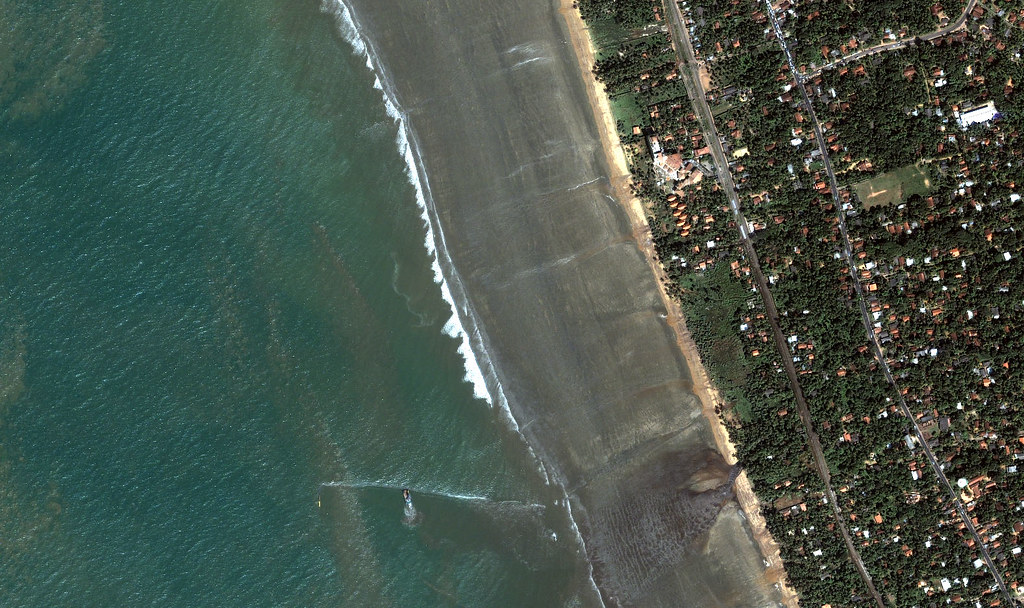
(above) the ocean rapidly retreats 400 metres on the south-western coast of sri lanka, just 5 minutes prior to the arrival of a devastating tsunami.

(above) the swirling waters continue to batter the coast just moments after the main wall of water has hit.
2. an alluvial fan, xinjiang province, china

(above) covering an area 56.6 x 61.3 km and taken on may 2nd, 2002, this photo shows an alluvial fan that formed on the southern border of the taklimakan desert in china. an alluvial fan usually forms as water leaves a canyon, each new stream eventually closing up due to sediment - the result being a triangle of active and inactive channels. the blue ones on the left are currently active.
3. retreating glaciers in the bhutan-himalaya

(above) a beautiful but clear sign that glaciers are slowly melting due to global warming. easily visible are the ends of most of these glacial valleys’ surfaces turning to water to form lakes, a trend which has been noticed only in the last few decades.
4. hurricane isabel, 2003
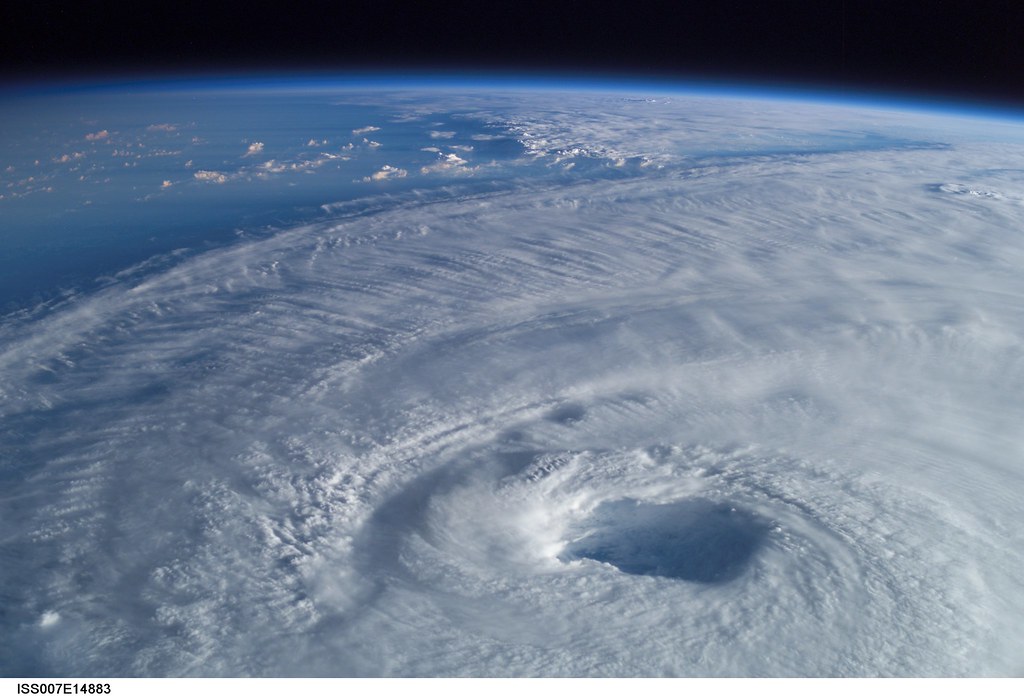
(above) this terrifying photo of hurricane isabel was taken on the international space station in 2003 and illustrates the immense size of the hurricane’s eye. this particular hurricane was the deadliest of 2003 and winds reached 165 mph at its peak.
6. greenland’s eastern coast, august 21st, 2003
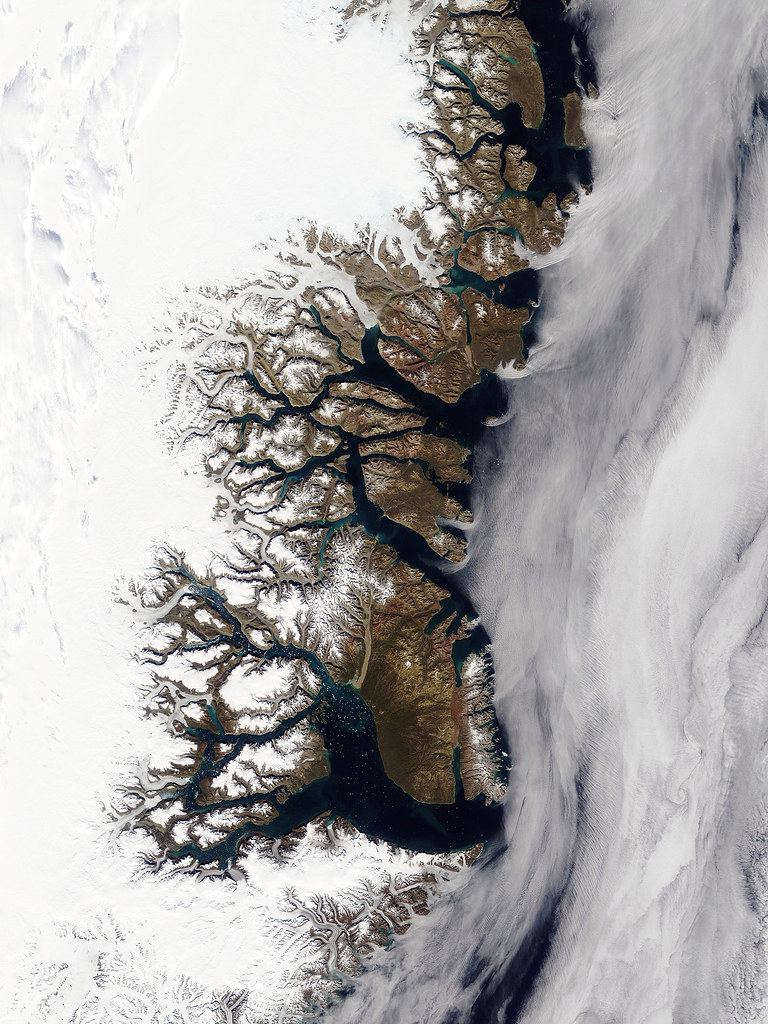
(above) the fractal coastline of greenland and its numerous fjords as seen from space.
‘little spots of white in the water seem to be ice originating from the deeper fjords that reach all the way to the icecap covering most of the island.’ link
6. aurora borealis
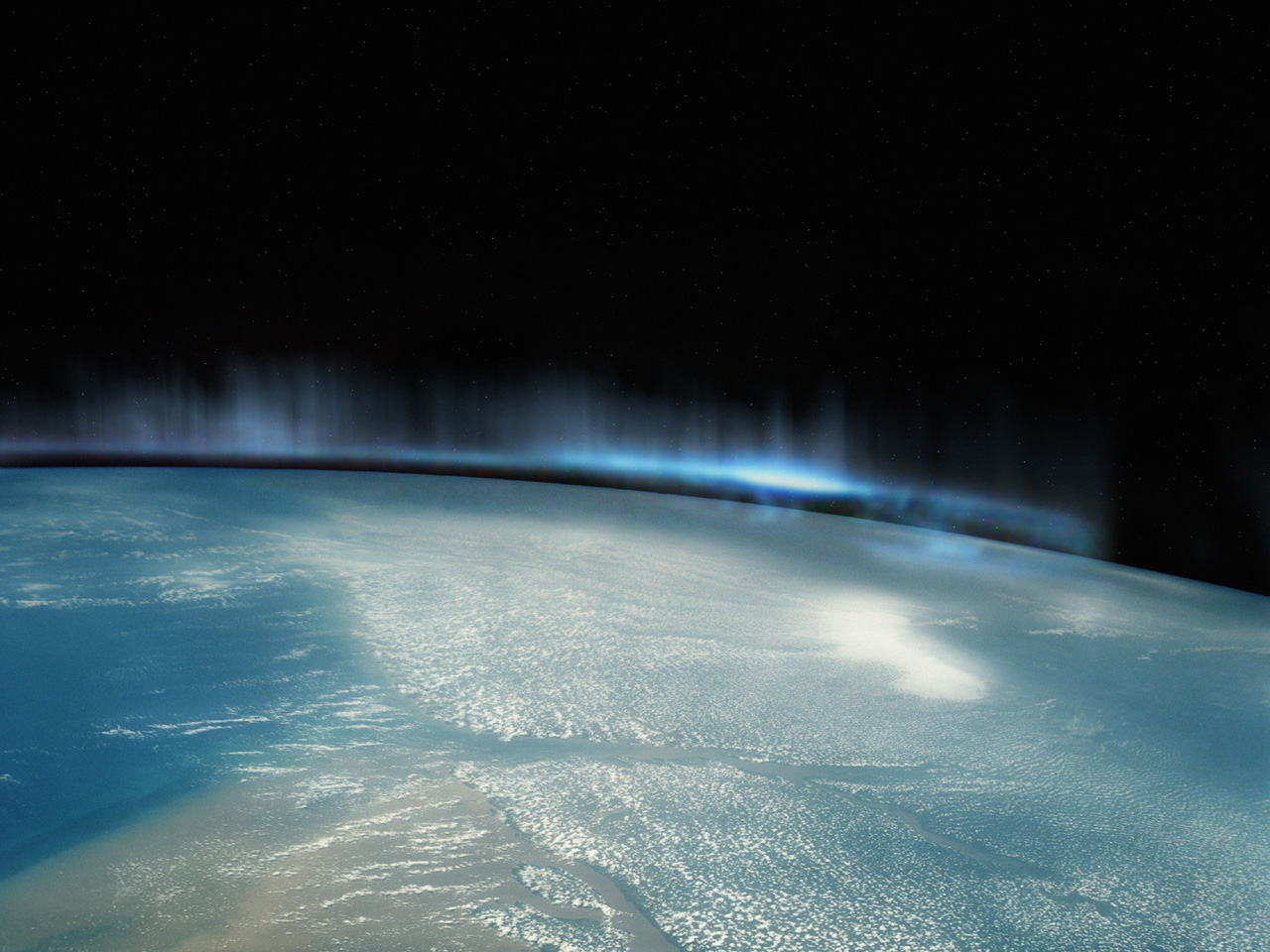
(above) an astounding and spooky photo of the natural phenomenon known as aurora borealis, taken on-board space shuttle atlantis during the sts-117 mission.
7. a total solar eclipse from space, 1999

(above) the shadow of the moon covers part of earth on august 11th, 1999 in this photo taken from mir space station. this shadow raced across earth at 2000 km/h, all areas under the centre of it plunged into darkness during a total solar eclipse. this was apparently one the final photos taken from mir.
8. egmont national park, new zealand
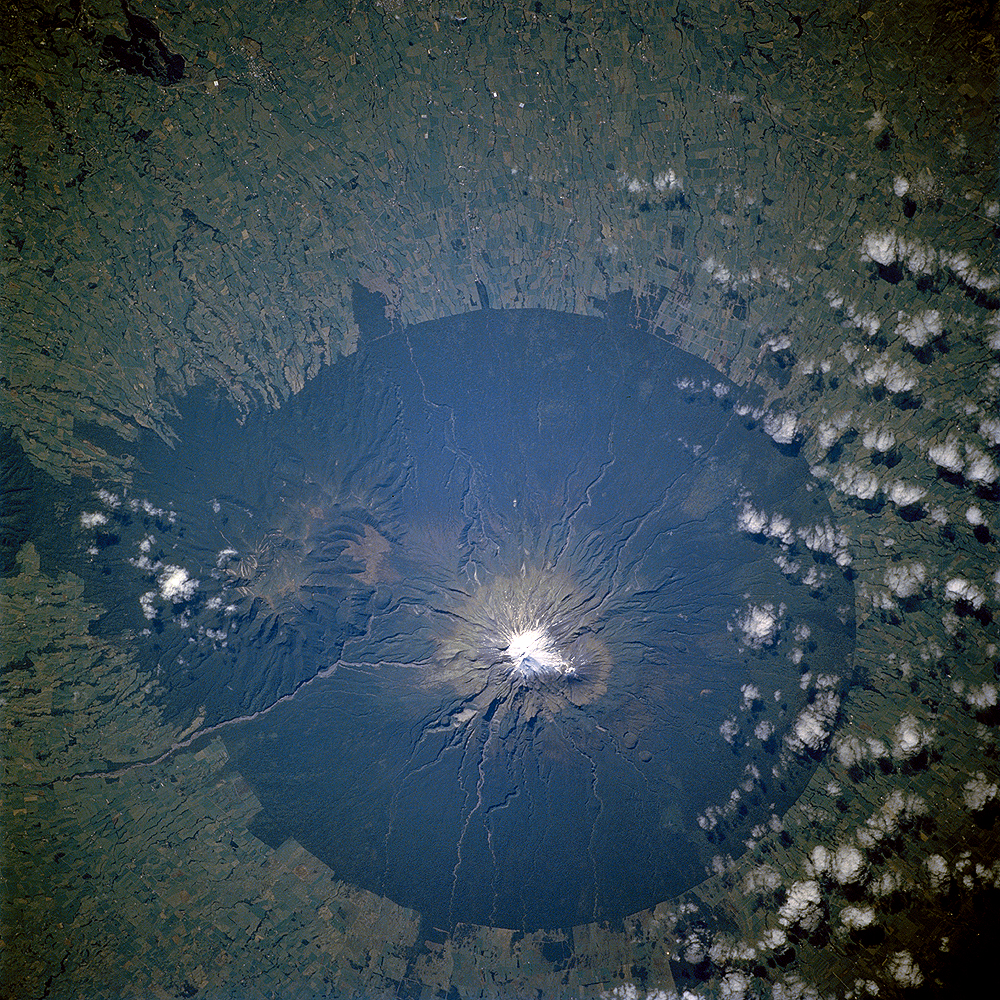
(above) mt. egmont volcano last erupted in 1755 and is now situated at the centre of egmont national park. park regulations have ensured the survival of a forest which extends at a 9.5 km radius from the summit of the volcano, the result of which can be seen from space in the form of huge dark green disc. this photo was taken during the sts-110 mission, april 2002.
9. mt. etna eruption, october 2001
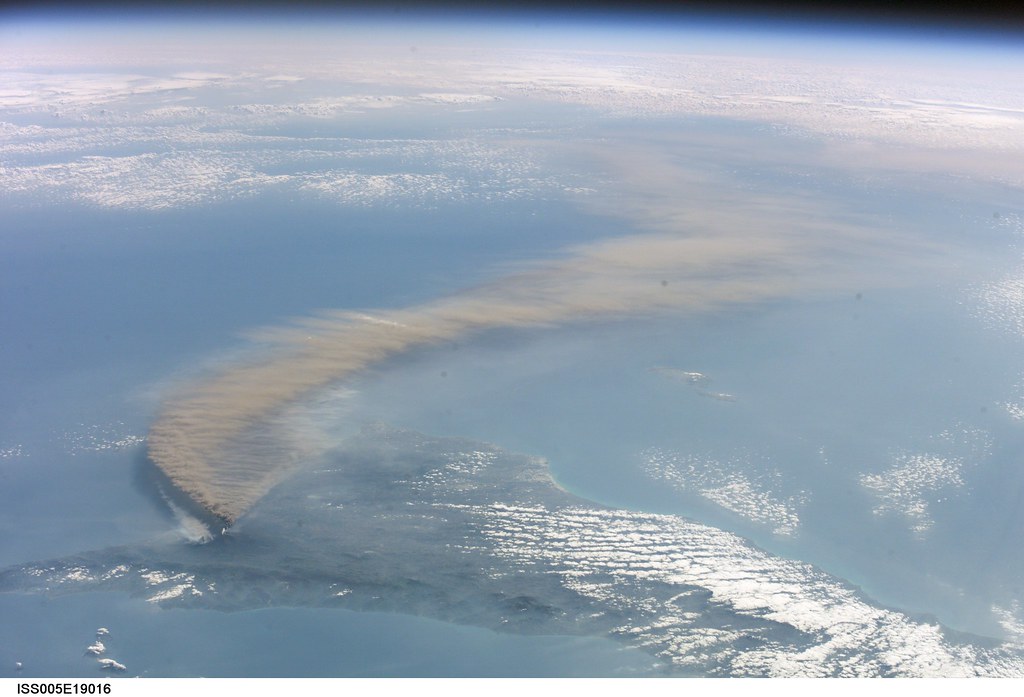
(above) taken from the international space station in 2001, this is a photo of a particularly violent eruption on the island of sicily which produced a cloud of ash that travelled as far as libya. on the humongous version of the photo lighter coloured smoke can be seen near the volcano - this was caused by lava igniting nearby forests.
10. richat structure, mauritania
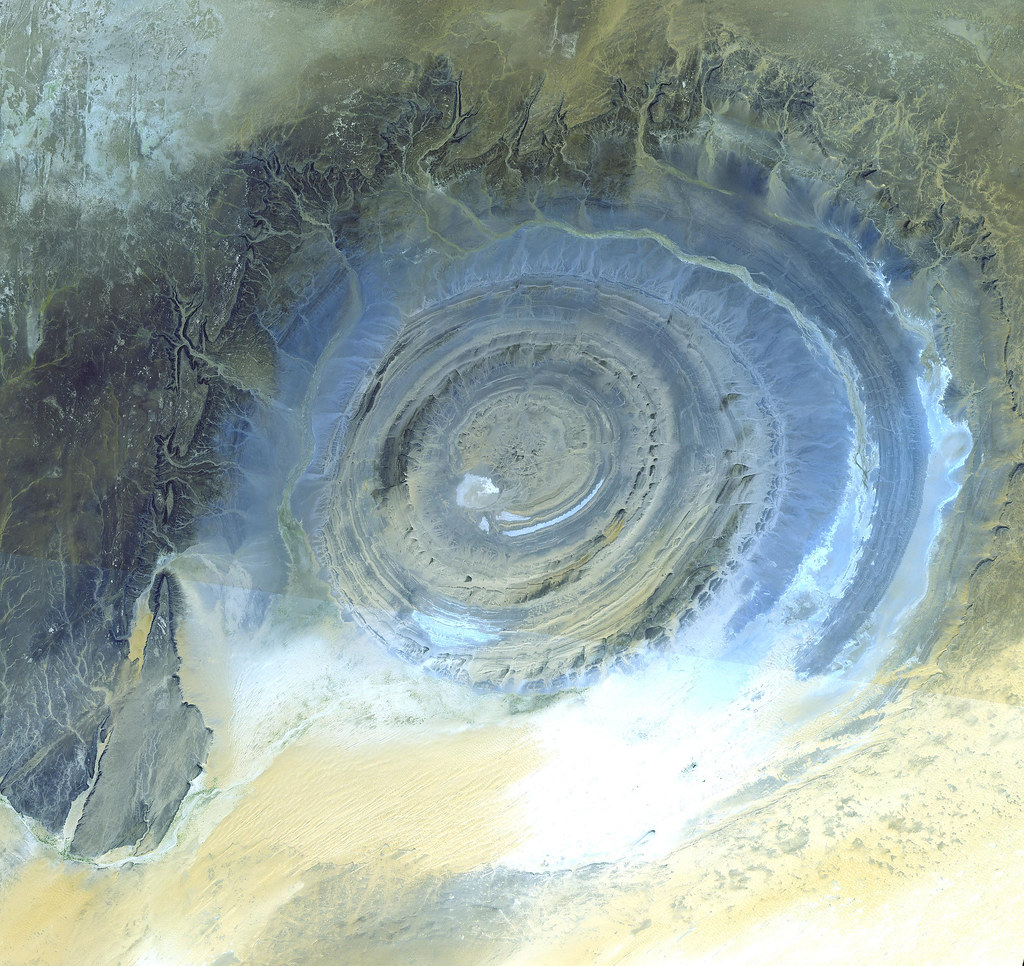
(above) the cause of the richat structure in the sahara desert of mauritania has been debated for many years. at first it was thought to be a meteor impact crater due to its circularity but this has since been disproven due to the lack of shock-altered rock in its vicinity. this massive (30 mile diameter) oddity is now believed to have been a rock dome sculpted over time by erosion. this incredible image was taken by the advanced spaceborne thermal emission and reflection radiometer (aster) on october 7th, 2000.
Thursday, November 1, 2007
Indian in Australia scoring high with Hindi
An increasing number of Indian-origin students in Australia are choosing Hindi as a subject for the High School Certificate (HSC) or Class 12 exam to improve their overall percentage and seize the opportunities offered by India's economic growth.
Jasmine Sodhi, who migrated here at the age of eight, has just done the voiceover in Hindi for one of Australia's most successful children's entertainment programmes, 'The Wiggles', for the Indian market.
She said, "Learning Hindi has opened up many opportunities. It will be of great help if I choose to work in India as I can now interact with different people with ease."
Fluent in French and English, Jasmine has been attending the Sunday Hindi classes for the past six years. She said, "I have chosen Hindi for HSC to scale my UAI."
UAI or University Admission Index is a numerical measure of a student's overall academic achievement in the HSC exam. It is used to determine a student's eligibility for admission to undergraduate courses.
A spokesperson for the Board of Studies of New South Wales said, "In 2007, 40 students enrolled in the HSC Hindi Continuers course in the state. In 2002, there were only eight students enrolled in the course. The biggest jump occurred in the past year with the number of candidates nearly doubling from 22 in 2006 to 40 in 2007."
Cheshta Hooda, who topped the state in Hindi in 2006, came to Australia at the age of 13 and had not studied Hindi after Class 5.
"I joined Hindi in Class 11 to score a higher UAI. It took a couple of months to get back into the groove of reading and writing the language, but now I can talk to naniji without needing mummy to translate the bits I didn't understand earlier."
"I can also better follow the epics, Mahabharat and Ramayan, and enjoy Bollywood films without having to concentrate on subtitles," she said.
"The way Hindi is taught here is very different to the 'learn by heart' concept followed in India. Here, we do a lot of listening tasks and translation, which is difficult, but it tests one's command over Hindi and English," added Cheshta, whose mother used to be a Hindi teacher in Mussoorie.
Abhishek Sood, who migrated at the age of 12, said, "The prospect of high UAI lured me to do HSC Hindi, and then my mother, who had been a Hindi teacher in India for 16 years, was also there to help. Here, the essence is to make you conversant in Hindi and the focus is largely on speaking skills. You can respond to a lot of exam questions in English."
However, the HSC Hindi course has helped him retain the writing skills and he enjoys writing letters in Hindi to his grandparents back home in India.
Most migrant children attend the Sunday Hindi classes at the Indo-Australian Bal Bharati Vidyalaya in suburban Sydney. The Vidyalaya has come a long way since its inception in 1987 when a group of mothers, some with teaching backgrounds, started the Hindi classes.
Mala Mehta, the honorary founder, coordinator and teacher at the Vidyalaya, said, "I used to teach Hindi to my daughter at home but she kept winging and found learning by herself a chore. So a group of mothers got together to set up the school and make learning Hindi fun. We started with 35 students and now have about 150 students and 11 trained teachers."
Most students who take HSC Hindi secure 80 percent or more marks. The students are tested for speaking, listening, reading and writing skills. The text is interactive and contemporary, based on current affairs and topical events.
The Vidyalaya also has classes for adults. For example, some medical students are learning Hindi to gain clinical experience in India and a few Australians are learning the language to live up a dream in Bollywood.http://www.dnaindia.com/report.asp?newsid=1131059
Four Famous Ghost Pictures
Everybody loves a good ghost story, so here's four pictures taken by ghost hunters over the years. A couple are quite famous. Ghost Hauntings has a full explanantion and both sites mentioned below have more pix on the subject.
From Idaho Ghosts the World Trade Towers 'face in the smoke':
Another creepy 'face from the smoke' picture:
The famous Newby Church ghost picture's next. From Ghost Hautings:
And lastly, another from Ghost Hauntings, this time the famous "Toys-R-Us Ghost". This last one was shot under extremely verifiable circumstances after the store suffered many strange happenings and a psychic was called in.
http://deathby1000papercuts.blogspot.com/2007/10/pixelaneous-four-famous-ghost-pictures.html


